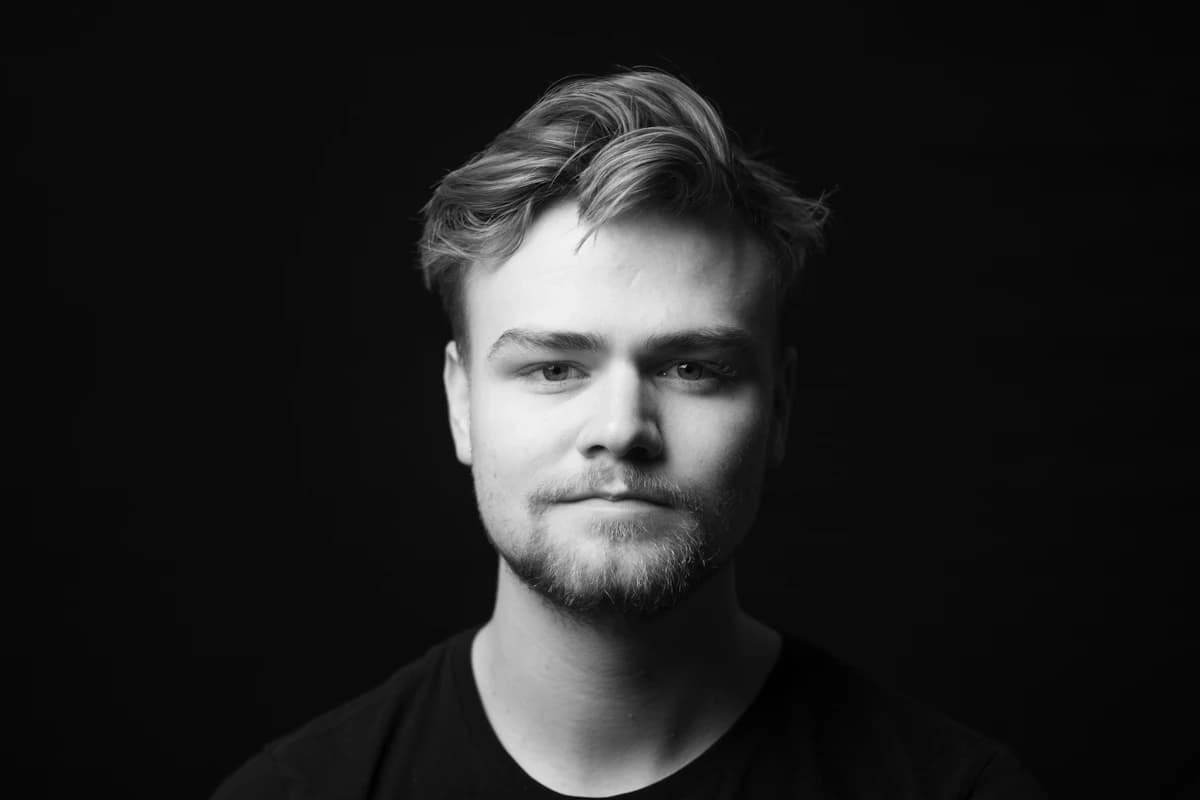
Facial thirds divide your face into three horizontal bands; facial fifths divide it into five vertical columns, each one eye-width wide. Roughly equal thirds and evenly spaced fifths are what classical art called balanced proportion, and what modern face-analysis tools still measure. They're genuinely useful as a measurement framework — and considerably less prescriptive than the internet treats them.
The horizontal thirds
Draw three lines across a front-facing photo:
- Upper third — hairline to the brow line (glabella, the point between your brows).
- Middle third — brow line to the base of the nose (subnasale, where the nose meets the upper lip).
- Lower third — nose base to the bottom of the chin (menton).
Classical proportion says these should be approximately equal. In practice most faces show some variation, and a noticeably long or short lower third is the most common deviation — it's also the one people most often perceive as "something's off" without being able to name it.
The lower third has its own internal rule worth knowing: from nose base to the mouth line should be about one-third of it, and mouth line to chin about two-thirds.
A caveat on the upper third: it depends on your hairline, which recedes, shifts, and varies enormously between individuals. Many clinicians treat the upper third as the least meaningful of the three for exactly that reason. If your thirds look uneven because of a high hairline, that's a hairline measurement, not a facial structure one.
The vertical fifths
Now divide the face into five vertical columns, each roughly one eye-width across:
- Left edge of the face to the outer corner of the left eye
- The left eye itself
- The gap between the eyes (intercanthal distance)
- The right eye
- Outer corner of the right eye to the right edge of the face
The classical rule: all five are approximately equal. The practical implication is the one people find most useful — the space between your eyes should be about one eye-width. Wider is described as hypertelorism-adjacent, narrower as close-set.
Two further conventional checks: the width of the nose base should roughly match the intercanthal distance, and the corners of the mouth should align approximately with the pupils.
How to measure yours properly
The measurement is only as good as the photo, and this is where most self-assessments fail.
Shoot straight on, camera at eye level, from about 1.5 metres, even lighting, neutral expression, hair off the forehead. Then measure in any photo editor with a ruler or guide tool — or just use a physical ruler on a printout.
The errors that ruin it:
- Camera height. Above eye level compresses the lower third and lengthens the upper. Below does the reverse. This single variable distorts thirds more than any anatomical difference.
- Head tilt. Tilting forward or back changes all three bands at once.
- Lens distance. Close phone cameras enlarge central features, which throws the fifths off — especially the nose-width check.
- Smiling. Changes mouth position and cheek height. Measure at rest.
Do male and female proportions differ?
Somewhat, and less dramatically than the framing suggests.
Population averages show a few consistent differences: female faces tend toward a proportionally shorter lower third, a slightly higher brow position, and a more tapered lower face; male faces average a longer lower third, heavier brow ridge, and greater bigonial width. These are averages with enormous overlap, not two separate templates — plenty of individuals sit comfortably in the other distribution.
What's worth being blunt about: the "ideal female face proportions" diagrams circulating online are usually presented with a precision nobody has earned. They're derived from small, non-representative samples and then applied as though they were universal.
Where the rules break
Three honest limitations, because the thirds-and-fifths framework gets quoted far more confidently than it deserves.
Its origins are artistic, not empirical. These proportions come from Renaissance drawing convention — guidance for constructing a plausible face on a page, not findings from measuring attractive people. Their persistence reflects their usefulness as a drawing aid as much as anything about beauty.
The reference population is narrow. The best-known proportion frameworks were derived largely from white European faces and fit other populations' averages poorly. Measuring conformance to them measures conformance to one reference set, which is a different claim from measuring balance. We document this in our methodology.
Deviation is often the point. Editorial casting frequently selects faces that break these rules in a specific, memorable way — an unusually long midface, very wide-set eyes. Perfect conformance produces a face that photographs easily and reads as generic. Our guide to what facial features models actually have covers why that trade-off exists.
Thirds, fifths, symmetry and harmony — how they relate
These get conflated constantly, so briefly:
- Thirds and fifths measure proportion — how parts of the face relate in size and spacing.
- Symmetry measures left–right agreement, a completely independent property. See what a good symmetry score looks like.
- Harmony is the two combined into one impression — useful as a concept, misleading as a single number. We unpack that in good vs bad facial harmony.
A face can have textbook thirds and visible asymmetry, or perfect symmetry and a long lower third. That's exactly why collapsing them into one score throws away the information you wanted.
Measure it without the ruler
Our free face scan computes your facial thirds, fifths, intercanthal distance and length-to-width ratio from one photo, alongside 14 scored categories with a percentile for each — in a few seconds, free, no signup.
The standing caveat applies here as everywhere on this site: it measures a photograph against a convention. It doesn't measure whether your face is good.