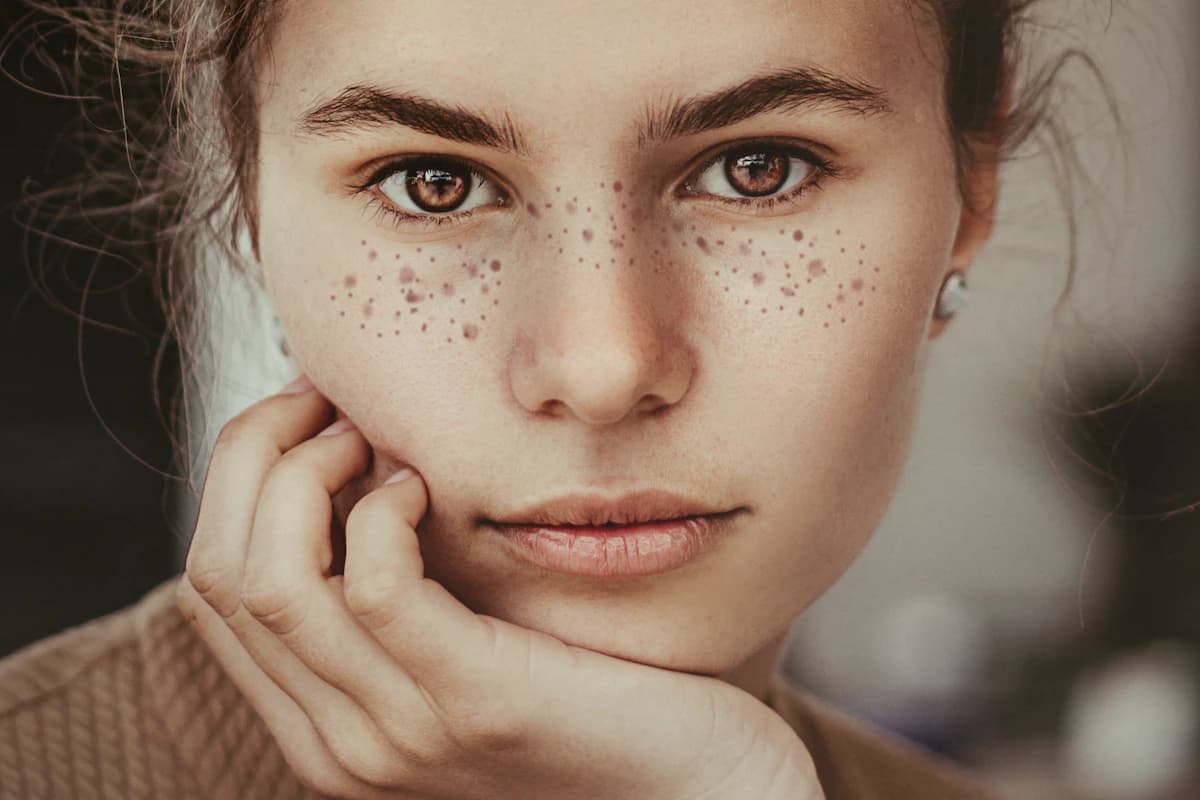
Short answer: most people score in the 80s. Anything in the low-to-mid 90s is unusually balanced, and scores under 70 almost always trace to one specific feature pair rather than a globally lopsided face. But the number is far less interesting than what sits underneath it — and it moves more with your camera than with your anatomy.
How a symmetry score is calculated
A face symmetry test draws a vertical midline through your nose bridge and philtrum, then measures how far each mirrored pair of landmarks sits from its reflected position: outer eye corners, brow peaks, mouth corners, the jaw contour, nostril edges. Those deviations are summed and normalized against face width, so the result is a proportion rather than a raw millimetre count — a 2mm offset on a narrow face means more than the same 2mm on a wide one.
That normalization is why you can't meaningfully compare a symmetry score from one tool to another. Different landmark sets, different midline definitions, and different normalization all produce different scales. A 91 here and an 84 elsewhere are not a disagreement about your face; they're two different rulers.
The rough bands
- 90–100 — unusually balanced. Mirrored pairs agree closely across the whole face. Uncommon, and worth noting that photographers often find perfectly symmetric faces less interesting to shoot, not more.
- 80–89 — where most people land. Ordinary, healthy facial asymmetry: a brow a millimetre higher, a jaw contour slightly fuller on one side. Invisible in conversation.
- 70–79 — one or two feature pairs are carrying visible asymmetry. The breakdown will tell you which. Very often this is photo-induced rather than anatomical.
- Below 70 — usually means head rotation, camera angle, or one-sided lighting rather than facial structure. Retake and rescan before concluding anything.
Perfect symmetry doesn't exist — and isn't the goal
Every facial-morphology dataset ever assembled finds measurable asymmetry in every face. Some of it is developmental, some is habitual (chewing side, sleeping position), some is just how bilateral organisms grow. Mild asymmetry is a description of normal anatomy, not a flaw to correct.
There's a well-known demonstration of this: take a portrait, mirror one half onto the other, and you get two faces that are perfectly symmetric and both look subtly wrong. Studies asking people to rate mirrored composites against the originals frequently find the originals preferred. Symmetry correlates with rated attractiveness, but weakly — averageness, skin quality, and youthfulness all explain more of the variance. That's exactly why symmetry is one of 14 scored categories in our scan rather than the headline number.
Why your score changes between photos
This is the single most common question, and the answer is almost always the photo:
- Head rotation. A few degrees of turn shortens one side of the face in the frame. The AI measures what the image shows.
- Camera height. Shooting from above or below tilts the facial plane and compresses one half more than the other.
- Lens distance. Close-range phone lenses stretch central features outward; if the camera isn't perfectly centred, that stretch is uneven.
- Lighting. A single side light puts one half in shadow, which changes where the landmark detector places contour points.
For a read you can trust: rear camera, roughly 1.5 metres away, camera at eye level, face square to the lens, soft even light, neutral expression. Scan two or three such photos — if the score is stable across them, that's your real number.
What the score doesn't tell you
It doesn't tell you whether you're attractive, and it can't. It measures geometric agreement between two halves of a photograph, which is a real property of a real image, but attraction runs on expression, movement, voice, and context — none of which a still frame contains. Our methodology page documents the model's limitations, including the biases it inherits from its training data.
One practical note: if you notice asymmetry that appeared suddenly, is progressing, or comes with drooping, numbness, or difficulty moving one side of your face, that's a medical question and worth raising with a doctor promptly — not something a face-rating tool is equipped to assess.
Check your own
Our face symmetry checker scores your left–right balance in seconds, free, with the per-feature breakdown that tells you where any asymmetry sits — and the other 13 facial categories alongside it, so you can see the number in context instead of in isolation.