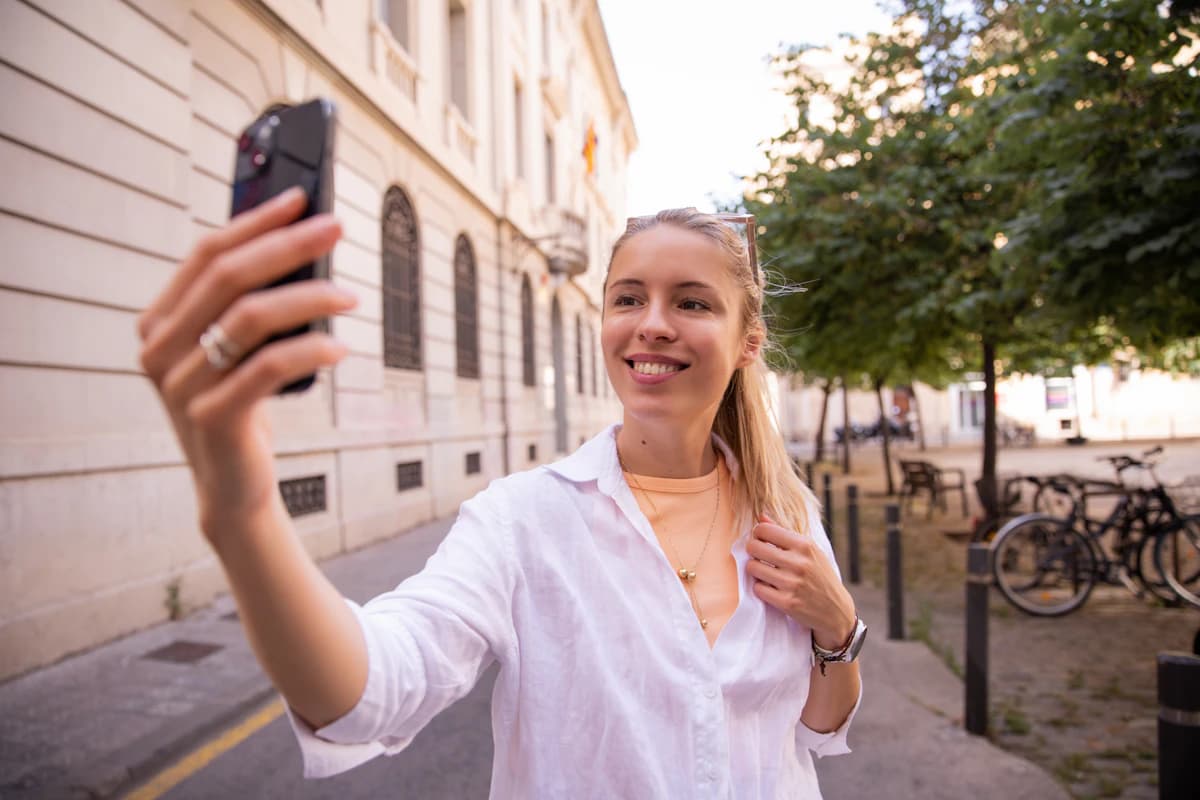
AI face ratings are good at ranking faces and bad at the number itself. In published comparisons, AI raters put faces in roughly the same order a group of people would, but they score almost everyone higher than people do, and the score moves with the photo far more than most users expect. So whether one is "accurate" depends on which of those two things you mean.
Studies below were checked in October 2026. One is a preprint that has not yet been peer-reviewed; it is flagged where it comes up.
What "accurate" means here
There is no ground truth for attractiveness. Researchers measure an AI rater against the average score a group of people gave the same photo, and that comparison can be checked two separate ways:
- Ranking. Does the AI put faces in the same order people do? This is measured by correlation, written r: 1.0 is perfect agreement, 0 is none.
- Calibration. Is the number itself right? If people average a face at 5 out of 10 and the AI says 7, the ranking can still be perfect while every score is inflated.
Most face-rating marketing talks about the first and quietly skips the second.
What the studies found
Dedicated face-rating websites. A 2023 study in Facial Plastic Surgery & Aesthetic Medicine by Goshtasbi, Hakimi and Wong ran 40 frontal photos through five free rating sites and compared the results with 24 human raters. Averaged together, the sites agreed strongly with the humans on ranking (r = 0.84). But they rated higher: people averaged 5.0 out of 10, the sites 6.9, and 30 of the 40 photos scored significantly higher from the AI. The sites also disagreed with each other. AttractivenessTest tracked the human ranking closely (r ≈ 0.87); PrettyScale barely did (r ≈ 0.32) and gave the highest average scores of the five.
ChatGPT, Claude, Gemini and Grok. A September 2026 preprint by Grandas, Murphy and colleagues asked four general-purpose AI models to rate 102 faces that 2,513 people had already rated on a 1–7 scale. The models reproduced the human ranking about as well as a typical individual person did. But people averaged 3.02 and the models 4.71, and no model gave any face the lowest score. The researchers' explanation is that models tuned to be agreeable lean toward polite, positive answers.
Purpose-built research models. On the SCUT-FBP5500 benchmark, 5,500 faces each rated by 60 people, a standard deep-learning model reached r ≈ 0.90 against the average rating. Treat that as the ceiling under clean conditions: curated, front-facing photos, scored against the same kind of photos the model learned from. A phone selfie taken in a bathroom is not that.
Can ChatGPT rate your attractiveness?
It will give you a number, and the number will probably be flattering. On the evidence above, a chatbot is a reasonable judge of whether one photo of you is stronger than another, and a poor judge of where you actually sit, because it compresses everyone toward "above average". If you want an opinion that is less inflated, ask it to compare two of your photos rather than score one.
Why your score changes between photos
Every rater, human or AI, scores a photograph, not a face. The things that move the number most are things you control:
- Lens distance. An arm's-length phone selfie widens the nose and narrows the jaw compared with the same face photographed from about 1.5 metres.
- Light. Flat front light hides bone structure; harsh overhead light exaggerates skin texture and under-eye shadow.
- Angle and expression. A slight head tilt changes every symmetry measurement, and a big smile changes your facial thirds.
- Crop and resolution. A small, blurry or partly covered face gives landmark detection less to work with.
Run three different photos and you will see your range. The range is the honest result; any single score is one sample from it.
Where WannaModel stands
We do not publish a correlation between our scores and human raters, because we have not run that study on our own model, and we would rather say so than quote a number we cannot back up. What we do publish is on our methodology page: separate male and female models trained on 30,000 labelled photos, what your score is compared against, and the biases the model inherits from modeling photography.
Two things we can say plainly. The same photo always returns the same score. And the score measures how closely one photo matches modeling-photography conventions, not beauty, and not how people will react to you in person.
If you are comparing tools, borrow the questions the researchers asked. Does it explain what it measures? Does it say what it was trained on? Does every face come back above average? Our roundup of free face-rating tools covers which apps answer the first two.
How to read any AI face score
- Trust the ranking more than the number. Comparing your own photos against each other is where these tools are strongest.
- Assume inflation. A score above the middle of the scale is normal, not a compliment.
- Read the breakdown, not the headline. Which features carry your score tells you more than one blended figure. Our guide to what a good symmetry score looks like shows how a single category reads.
- Don't convert between scales. A 7 on one app and a forum PSL rating are different rulers; the PSL scale explainer covers why they don't map onto each other.
One thing worth saying directly: if you are re-scanning because a number stung, more scans from more tools will not settle it. These tools measure photos against a narrow industry template, and the research says even the best of them cannot tell you how people actually see you.
Try it on your own photos
Our AI face rating is free with no signup: you get your overall score and top 3 traits in a few seconds. Try two or three photos in different light and compare them, which is the way of using it the research supports. And the standing caveat: a score describes a photograph, not a person.
Sources
- Goshtasbi K, Hakimi AA, Wong BJF. Artificial Intelligence Versus Human Focus Group Rating of Facial Attractiveness. Facial Plastic Surgery & Aesthetic Medicine, 2023.
- Grandas S, Cely-Acosta JS, Mendiratta M, Hassan S, Murphy M. Beauty is in the AI of the beholder: MLLMs systematically overrate facial attractiveness. arXiv preprint, September 2026 (not peer-reviewed); PsyPost summary.
- Liang L, Lin L, Jin L, Xie D, Li M. SCUT-FBP5500: A Diverse Benchmark Dataset for Multi-Paradigm Facial Beauty Prediction. 2018.