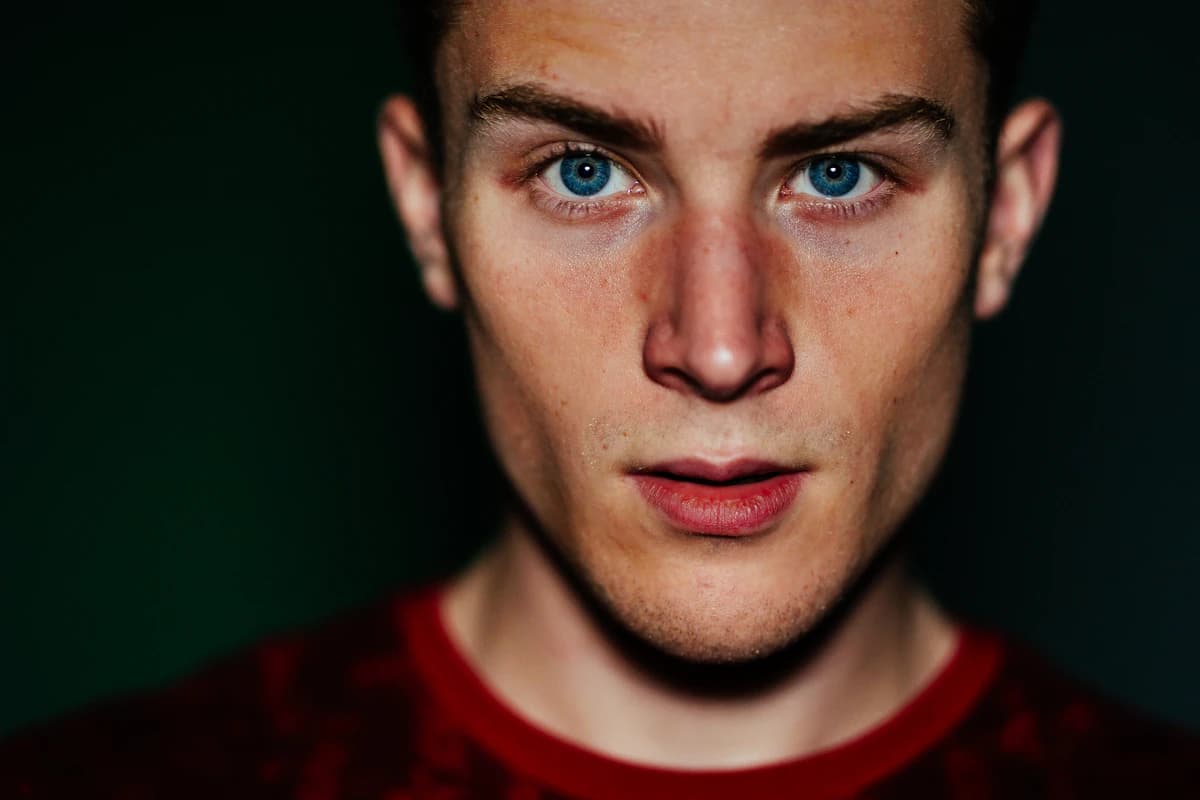
Canthal tilt is the angle of the line drawn from your inner eye corner to your outer one. Positive means the outer corner sits higher; negative means it sits lower. "Hunter eyes" is the TikTok label for a cluster of traits that usually includes positive tilt, deep-set eyes, visible brow ridge and low eyelid exposure. The anatomy is real and measurable. The significance the internet assigns to it is not, and the gap between those two things is worth understanding before you go measuring.
The actual measurement
Find the two corners of one eye. The inner corner (medial canthus) sits near the nose; the outer corner (lateral canthus) sits toward your temple. Draw a line between them, then compare it to horizontal.
- Positive canthal tilt — outer corner higher than inner. The line slopes up toward the temple.
- Neutral — the two corners sit level.
- Negative canthal tilt — outer corner lower than inner. The line slopes down.
Most people measure slightly positive. Reported population averages land in the low single digits to around 5–8 degrees positive depending on the study and the population sampled, and there is meaningful variation by ancestry. Which means: if you measure a small positive tilt, you are normal, not exceptional.
How to check yours properly
This is where most people get a wrong answer, because canthal tilt is very sensitive to how the photo was taken.
Photograph yourself straight on, camera at eye level, from about 1.5 metres, in even light, with a neutral expression. Then draw a horizontal reference line across the photo and compare your corner-to-corner line against it.
Things that will give you a false reading:
- Head tilt. Tilting your head a few degrees rotates the whole measurement. This is the single most common error.
- Camera height. Shooting from above drops the apparent outer corner; shooting from below raises it. A phone held high has manufactured negative tilt in millions of selfies.
- Front camera at arm's length. Short lens distance distorts the periphery of the face, which is exactly where the outer corner is.
- Smiling. The cheek rises and pushes the lower lid up, changing the visible corner position.
- Eyelid hooding. Hooding hides the true corner position, so people frequently mistake a hooded positive tilt for a negative one.
If you measured negative tilt from a selfie taken with your phone above your face, remeasure before concluding anything.
Hunter eyes is more than tilt
The "hunter eyes" label bundles several separate features, which is part of why the term is slippery:
- Positive or neutral canthal tilt
- Deep-set eyes — the orbital rim projecting forward relative to the eye
- A prominent brow ridge, which creates the shadowed, hooded look
- Low upper-eyelid exposure — less visible lid space above the eye
- An almond rather than round eye shape
The contrasting internet term, "prey eyes," describes the opposite cluster: rounder, more open, more lid exposure, neutral or negative tilt. Worth saying plainly — that framing is a piece of online slang with a nasty implication baked into it, not a category anyone in anatomy or casting uses.
Most of these traits are orbital bone structure. You inherit them.
The part the trend gets wrong
Here is the honest assessment, and it will disappoint the forums.
The differences are tiny. The gap between a tilt people call "positive" and one they call "negative" is typically a few degrees — a couple of millimetres of corner height. People stare at their own eyes for hours convinced of a difference that a stranger could not detect across a table.
The evidence is thinner than the confidence. Facial attractiveness research consistently finds that averageness, symmetry, skin quality and youthfulness explain far more of the variance in rated attractiveness than any single periorbital angle. Canthal tilt appears in some studies as one contributing feature among many. It has nothing like the decisive role looksmaxxing culture gives it.
It's largely a photographic artifact in practice. Given how much camera angle moves the apparent measurement, a meaningful share of online tilt discourse is people comparing badly-shot selfies to professionally-lit editorial photographs, where the model was shot at eye level with a long lens by someone who knew what they were doing.
What actually changes it — and what doesn't
Nothing non-surgical changes canthal tilt. The angle is set by where the lateral canthal tendon attaches to the orbital bone. No exercise, massage, tongue posture, or product moves that attachment. Claims otherwise are false.
Surgically, lateral canthoplasty and canthopexy do reposition the outer corner. These are real oculoplastic procedures with real risks — dry eye, asymmetry, changes to lid function — and they belong in a consultation with a qualified oculoplastic surgeon, not a comment section.
What genuinely changes how your eye area reads on camera: sleep and under-eye condition, brow shaping, lighting that produces catchlights, and shooting at eye level. Our methodology page covers what the scan measures across all 14 categories, and why lighting moves the eye-area scores so much.
One thing worth naming directly, because anyone searching this topic will run into it: the looksmaxxing corner of the internet promotes practices — striking your own face to "reshape" bone among them — that cause fractures and nerve damage and reshape nothing. There is no version of that which works. If you're weighing something in that direction, talk to an actual maxillofacial or oculoplastic surgeon first.
A note on where this leads
Searches like this often start as curiosity and end somewhere heavier. The looksmaxxing communities that popularised canthal tilt — the same ones behind the PSL rating scale — also correlate with appearance-related distress and body dysmorphic patterns, and clinicians have been flagging it for a couple of years now.
So: if measuring your face has become something you do repeatedly, or a few degrees of eye angle is affecting how you eat, sleep, socialise or feel about yourself day to day, that's worth raising with a doctor or therapist. Not because the interest is silly, but because a two-degree measurement is not built to carry that much weight.
Measure it in context instead
Our free face scan measures canthal tilt as part of the eye-area score, alongside 13 other categories, with a percentile for each — deliberately weighted as one input among many rather than the headline number, because that reflects what the research actually supports. In your browser, in a few seconds. The scan is free with no signup; the full per-category breakdown is Pro at $2/month.
And the standing caveat we'd rather state than bury: any score here describes a photograph, not a person. Read our methodology for what the model measures and where it's biased.